


A Sister’s Perspective

Alleghany Art Collection
“A Sister’s Perspective” is intended to draw on the wisdom of our sisters in order to offer advice and thoughts on a variety of broad topics. We are grateful for the sisters’ willingness to share their wisdom with us.
“We Cannot do Everything….”: Reflections from a 16-day Experience in El Paso
Every morning, a part of my prayer includes one of the prayers of Saint Oscar Romero:
We cannot do everything, and there is a sense of freedom in realizing that. This enables us to do something, and to do it very well. It may be incomplete, but it is a beginning, a step along the way, an opportunity for the Lord’s grace to enter and do the rest.
The spirit of this prayer motivated me to volunteer this summer (July 13-29), welcoming the migrant community in El Paso, Texas, at Annunciation House’s Holy Family Center.
My stay began with two firsts: navigating alone an Uber ride from the airport and having a college student as a roommate during my stay. Holy Family Center is housed in a former elementary school that had been abandoned for 10 years. Two buildings are connected by an interior courtyard, with basketball nets next to clotheslines for hanging laundry. The entire complex is surrounded by a fence, three padlocked gates, and a large electronic gate that leads into the parking lot. The bedrooms for the volunteers are in the school building, while the kitchen, dining area, and center for the guests are in the former auditorium building.
When people enter the United States seeking asylum, they are processed and then sent to one of several centers. Holy Family Center often receives members of the same family. I learned that in recent months busloads of up to 80 refugees could arrive at once. By the time I arrived in El Paso, the numbers had lessened considerably due to the current government regulations. During my stay, a large arriving group included 20-30 people. The guests usually stay at the center for a day or two, as the center is just a stop on their journey before they travel to a more permanent destination, such as the home of a friend or relative who pay for their trip from El Paso to wherever they were headed in the U.S. Holy Family Center provides a place to stay, shower, eat, and rest in a safe environment.
A regular day at the center involved receiving a text that a bus with a certain number of guests would arrive at an approximate time. The volunteers would be ready to welcome the guests who arrive wearing vinyl bracelet IDs. Once the IDs were removed, the group would be led to a large room for intake. Volunteers would record each guest’s name, age, and eventual destination and informed guests that when they have information for their flight to their destination in the U.S., they should let the staff know so that rides and travel bags can be arranged. The guests were then shown to the showers and bathrooms. The adults—primarily women during my time—had ankle monitors put on them at the border processing, which may only be removed for a short time to charge the battery or to shower. The guests then go to the auditorium-type room, where they may choose a place to set up cots with sheets and blankets for themselves and their children. If the noon meal is not yet ready, the guests are accompanied to “la roperia,” where they may select a set of clean clothes and shoes since most guests only arrive with their processing papers. Mothers with babies or little children may also receive a highchair for meals, a playpen, and extra diapers.
 The meals at Holy Family are prepared by volunteer teams from parishes and other groups according to a well-developed schedule. When the meal is ready, all the guests sit at the tables and someone leads the group in prayer, and often song, to give thanks and bless the meal. The volunteers, like me, help in the kitchen and serve the meals. Guests are responsible for the clean-up. In between mealtimes, the adults may be seen checking emails and texts for information on their travel while the children are coloring, playing with the toys, or watching a movie. The guests may paint flowerpots in the art room, each inscribed with a message from the artist. These flowerpots are then displayed and offered for sale to visitors, serving to keep awareness of the migrant situation alive while also raising funds for the center and its guests.
Other services are often made available at Holy Family Center, such as a lawyer who speaks about the legal process and answers questions. On some scheduled days, a doctor sees the guests. At the evening meal, the process is repeated as was done at noon, and after the customary clean-up, the guests can get personal hygiene supplies as needed and settle in for the night. At 8:30 P.M., the center is locked, and one of the volunteers is on night duty, which means sleeping at the center to be attentive to any emergency needs. The children will often ask to watch a movie, and Disney films (in Spanish, of course) have provided innumerable hours of enjoyment. I had the privilege of doing the night duty twice and I am grateful to report that no one had any urgent needs during those times. At 7 A.M. the next day, the center is unlocked again, and a new day emerges.
Sometimes, a guest cannot move to their next destination in a day or two and must remain at the center for a week. During my stay, this occurred with Mari and her son, who were from Colombia. During her week at Holy Family, she shared many of her skills with all of us. She had had a restaurant in Colombia and was thrilled to be set loose in the kitchen cooking rice, beans, and arepas. She was also a beautician, so one Sunday afternoon, several of the women and girls had their nails painted by Mari! When she, her husband, and her son crossed the border, Mari’s husband was detained, and she did not know where he was. In the evenings, I would often find her in front of the large Our Lady of Guadalupe picture, leading the rosary and inviting others to pray with her. She is a strong woman and when she and her son finally got the airfare to move on to Pennsylvania, she instructed the other guests to continue with the chores, keep their faith, and pray for each other.
I have written much about what I saw and did during my time in El Paso, but I have yet to describe the refugees I encountered. The migrants I met —or, as they are called at Holy Family, the guests—came from Mexico, Bolivia, Colombia, Cuba, the Dominican Republic, Ecuador, El Salvador, Guatemala, Honduras, Nicaragua, and Venezuela. The oldest person I met was a 56-year-old woman; many were very young. Although there were a few men with children during my stay, most of the guests were women with children; one was a young mother, still nursing her little baby and with a two-year-old child in tow. Another woman was pregnant, and her due date was the very next day. She also had a four-year-old son with her. Another woman with a little son also had a baby who was sick with a fever. One woman made the arduous journey with her 11-year-old daughter, who could not walk. The guests usually spoke Spanish, but a very few spoke English; some spoke an indigenous language, like Quechua.
The migrant guests shared their stories of how they came up by truck or through the jungle (the Darien Pass). They relayed stories of how they were only given bread and water to eat on the journey or how their child cried because they saw how sad their mother was. Many did not know how large the U.S. was and how far the next point on their destination would be. It is hard to forget the young boy, who, when asked if his trip up to the United States had been okay, said no unequivocally. When asked why, he told of the things that had happened on the journey and how he had witnessed dead bodies, killings, and rapes. At the center, they were welcomed into a space that provided love and respite from the harrowing ordeal that many of them had endured for weeks or even months. The children loved to learn new words in English and were often ready to practice by saying “Good morning,” “Please,” and “Thank you.” They were thrilled to teach corresponding words in Spanish or how something would be said in their native dialect. One young girl had a talent for drawing and spent hours drawing pencil portraits of the volunteers. When the younger volunteer staff were present, the room was energized by blasts of salsa or rap music. Some of the kitchen volunteers would play oldies or Motown music which made the meal preparations enjoyable. The guests demonstrated a sense of community and compassion for one another. They prayed with astounding simplicity and humble gratitude for the blessings that they had been given. A true sense of joy was generated among the children, and dignity was felt among the adults who helped each other with the children with advice and encouragement.
Another hope during my stay in El Paso was to visit the border and possibly go across to Mexico. The border wall was very visible from the center. One day, one of the longer-term volunteers took another volunteer and me to “the wall.” We saw the border police and the gates and learned of certain gates that get periodically opened—offering opportunity to enter. There were no crowds of people climbing walls to get into the country, nor lines of people being held at the wall for trying to breach it or being pulled down from climbing it. The wall had some notorious checkpoints, but during the time I was there, it was eerily silent. When we ventured into Mexico, we walked across the bridge into Juarez. We visited the cathedral, and when we walked back to El Paso, we walked on the other side of the bridge and had IDs ready to show the police at the various checkpoints. Cars were in line to pass into Texas, but the wait time for the vehicles was perhaps two hours. Walking was more straightforward and faster. There is a legal flow of daily traffic to and from El Paso and Mexico, but the lines and the wait are unbelievably long every day.
Besides volunteering at Holy Family Center, I was able to see the other centers associated with the Annunciation House—Annunciation House, Casa Papa Franciso, and Casa Rita Steinhagen. Each of the centers has resources to accommodate various needs and is staffed by volunteers. In fact, the whole ministry is run and staffed by volunteers and funded by donations. It is a fantastic testimony to a belief in the Gospel message and to serving the poor in simplicity. There were several college students and young adults who volunteered for a month, a summer, or a year. They were edifying in their generous giving of time, energy, laughter, etc., to the guests. There is a sense of intercommunity that seems to supersede religious congregations and denominations. I learned so much from the young volunteers that I met; even my roommate was an amazingly talented woman who used her organizational skills and energy in culinary, technological, and artistic ways.
On another day, I was brought to visit the three Spanish missions still in use. I had lunch at a women’s cooperative and restaurant, all run by women and for the benefit of the women laborers. I also went to Santa Catalina—a school that also houses a shop that sells things in person and online made by the migrant women and the women in Juarez. The profits go back to the women. I also saw a series of street murals that keep history alive.
During my two weeks in El Paso, I met several women and men from religious congregations, like the OFM Conventual priest who founded Holy Family Center, the Friars Minor who volunteer and support the refugee ministry in many capacities, the Jesuit volunteers, the Marist brothers, the Sisters of Notre Dame de Namur, the School Sisters of St. Francis, the Daughters of Mary, Sisters of Charity, to name a few. All of those involved in welcoming the migrants were dedicated to this ministry and many of them served for years in the missions. I also met a number of lay volunteers who are regular workers at the Holy Family Center. They approached each day with joy and commitment, and each guest was a unique guest for them to serve.
There are so many moments that will not make it into this article since the heart’s experience cannot be depicted merely by words. Yet one point is certain: the migrant guests come to the U.S. from many backgrounds and situations, and all want a better life. I was humbled by the guests I met—by their humility, gentleness, prayerfulness, deep sense of love for family, gratitude and respect for our country, and appreciation for whatever they have received. They demonstrated a reliance on Providence and a desire to do whatever was needed for the good of their families.
Migration is a big part of the rhetoric in these pre-election weeks. As you read about my small, insignificant service experience, I ask that you remember that each of the migrants is a person. In our commitment and dedication to the Gospel and to the charism given us by Mother Francis, we should reread and reflect again on Saint Oscar Romero’s prayer from the beginning of this reflection.
I thought that my bilingual skills would be a great help as a volunteer in El Paso, but I did not do anything great. But through the little I did do, I know that God’s grace put me there at this particular time and that, because of that grace, my life will never be the same. I wish you peace and all good.
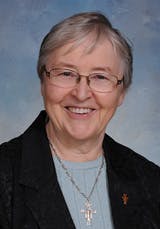
Linda Marie Sariego, OSF

